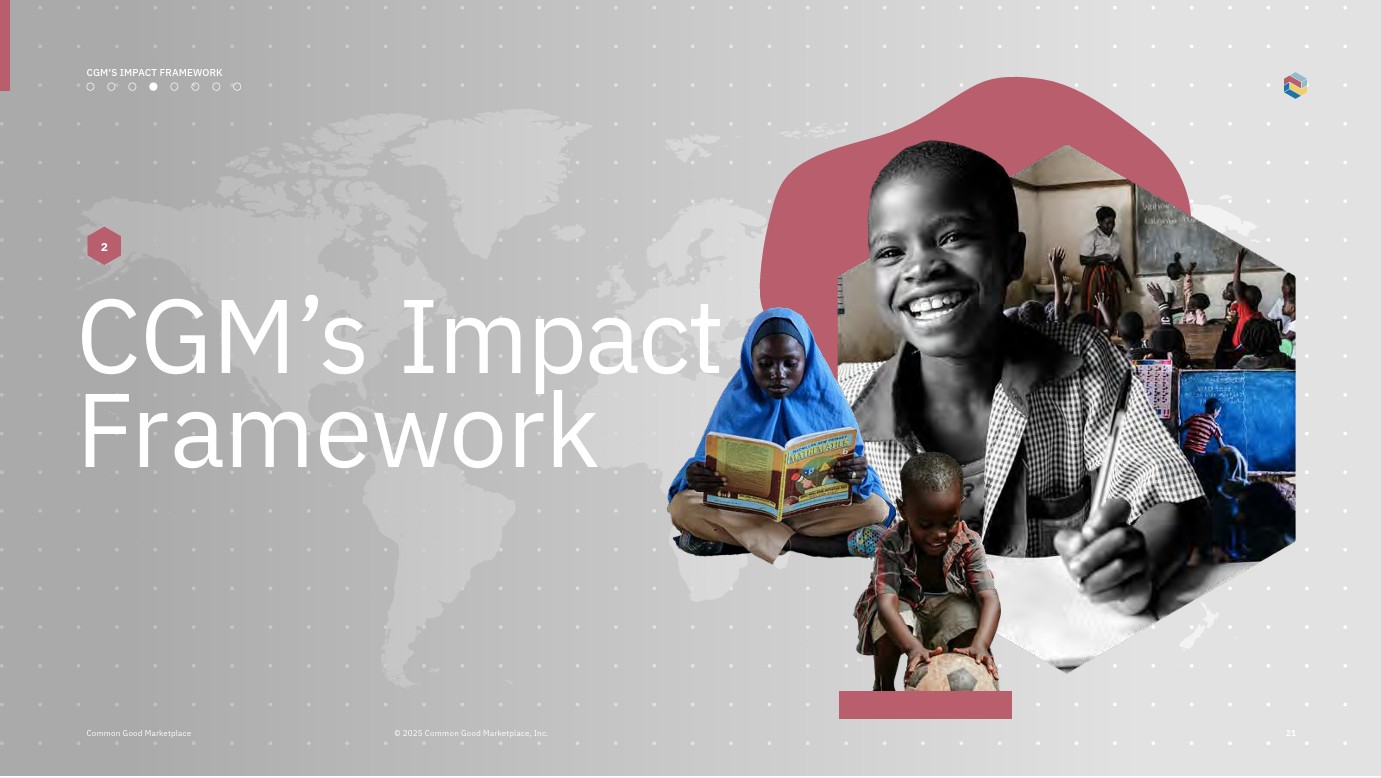
.png)
One Year On: Is Tradeable Impact Moving Toward the Mainstream?
One year ago, the World Economic Forum's Global Alliance for Social Entrepreneurship released a landmark whitepaper exploring a bold yet practical idea: what if value could be redefined by taking the principles of outcome-based funding and building them into a functioning market for verified impact?
The premise was not simply that we need more capital for social and environmental challenges. That is too obvious. The deeper question was whether the way capital is allocated, how outcomes are verified, and how claims are made is fit for purpose.
Across development finance, philanthropy, corporate sustainability, and public funding, the dominant models still struggle with familiar constraints. Funding is often fragmented, incentives are frequently tied to activities rather than outcomes, impact claims are difficult to attribute, reporting is inconsistent, and Social Value is rarely comparable (if captured at all) across interventions, geographies, or sectors. And capital often flows based on relationships, narratives, or institutional priorities rather than verified evidence of improved human well-being.
The WEF whitepaper asked whether a different architecture is possible: one where verified outcomes can become investable, comparable, and eventually tradeable units of value.
At Common Good Marketplace, we wholeheartedly believe the answer is YES, which is why we participated in this research in the first place.
Why a Market for Verified Impact Matters
Outcome-based funding has already shown that tying payments to results can improve accountability and effectiveness. But many outcome-based models remain bespoke, expensive, time-consuming and difficult to scale. Each transaction often requires its own structure, funder agreement, measurement framework, verification process, and repayment logic, which limits adoption.
A market for verified impact takes the logic of outcome-based funding subsumes it and makes it more scalable. Instead of building every deal from scratch, it creates a shared infrastructure through which social outcomes can be measured, verified, certified, issued, and then purchased. This is critical for several reasons.
First, it can improve capital allocation efficiency. Funders, companies, donors, and public institutions need better ways to identify where capital is creating real, measurable value. A verified impact market allows capital to flow toward outcomes rather than assumptions.
Second, it can increase funding effectiveness. By linking funding to verified improvements in people's lives, the model creates stronger incentives for quality, depth, and durability of impact.
Third, it can strengthen attribution. In a crowded landscape of overlapping claims, verified impact assets can help clarify who created the outcome, who funded it, and what evidence supports the claim.
Fourth, it can make social value more comparable. The goal is not to reduce human flourishing to a simplistic metric. Rather, the goal is to create enough standardization for decision-makers to compare opportunities, allocate capital more intelligently, and understand the relative value of different interventions.
Finally, it introduces a missing market-based mechanism into development and social impact. Markets are not a cure-all, and poorly designed markets can distort incentives. But well-governed markets can also unlock scale, discipline, transparency, and liquidity in ways that purely grant-based or project-based models often cannot.
CGM and the Pathway Identified by WEF
The WEF whitepaper prominently featured Common Good Marketplace and our market-based model for human flourishing.
It also described a potential pathway for how this market could evolve. The journey begins with early adoption, where pioneering organizations test the model, build confidence, and create case studies. It then moves toward mainstreaming, where more institutions begin integrating verified impact into funding, procurement, reporting, and investment decisions. Eventually, the market could move toward economic integration through global interoperability, where verified impact becomes part of broader financial, policy, and institutional systems.
That pathway is ambitious. It also requires serious guardrails. For tradeable impact to become credible, the market must be built on rigorous measurement, independent verification, clear additionality standards, transparent issuance, and safeguards against double counting or exaggerated claims.
What Has Changed One Year On?
But one year on, the direction of travel is becoming clearer. Tradeable impact is not yet mainstreamed. We are not yet in the second phase of broad institutional adoption. But we are seeing meaningful traction across development, philanthropy, and corporate sustainability.
Organizations are increasingly searching for models that are not only more effective, but also more sustainable. They want approaches that can connect impact measurement to funding, align capital with verified outcomes, and create stronger incentives for long-term social value creation.
Bayer Foundation offers one example. Through its work with Common Good Marketplace, Bayer Foundation is exploring how verified impact can help build the capacity of women-led social enterprises and unlock new pathways for social innovation financing. This is not just about reporting impact after the fact. It is about helping enterprises translate their outcomes into a form of value that funders and partners can better understand, trust, and support.
SAP offers another example. Through our work with SAP on social procurement, we explored how social value can be embedded into procurement strategy. Procurement is one of the most powerful but underutilized levers for corporate impact. If companies can better understand and verify the social outcomes created through their purchasing decisions, procurement can move beyond supplier diversity or ESG compliance and become a serious mechanism for delivering tangible human outcomes.
We are also seeing growing interest from development finance institutions across Europe and Asia. For DFIs, the appeal of tradeable impact is strategic. Many are under pressure to achieve development targets while also demonstrating measurable results, mobilizing additional capital, and improving the sustainability of funding mechanisms. Verified and tradeable impact creates a potential bridge between development objectives and market-based capital allocation.
At CGM, we are seeing this shift in our own marketplace. To date, CGM has transacted on $3.3 million of social value through the marketplace. That is still early, but it is no longer theoretical. The infrastructure is being tested, Suppliers are listing in the marketplace, Buyers are purchasing Verified Impact Assets™ (verified outcomes), and more and more case studies are emerging.
The Role of AI
The next stage of market development will almost certainly be shaped by AI (as with everything else).
AI can improve efficiency across data collection, impact measurement, verification workflows, reporting, and portfolio analysis. It can reduce friction for social enterprises and nonprofits that often lack the resources to build sophisticated measurement systems. It can help funders and companies analyze larger volumes of outcome data. It can make verification faster and less expensive.
But AI also creates new risks.
As impact reporting becomes easier to generate, the credibility of claims will become even more important. The market will need stronger assurance mechanisms, not weaker ones. AI can support verification, but it cannot replace trust. If anything, the rise of AI-generated reporting makes independent verification, transparent methodologies, and accountable governance more essential.
The organizations that succeed in this next phase will not be the ones that use AI to produce more polished impact narratives. They will be the ones that use AI to make credible, verified, decision-useful impact data more accessible and less costly.
From Sidebar Conversations to the Plenary
For years, outcome-based funding, impact credits, and tradeable impact have often lived in the side rooms of major conferences. They have been the domain of innovative finance specialists, development economists, and a small group of practitioners who believe deeply in the promise of results-based capital. This, however, is changing.
The language still needs to become clearer for sure. The models still need to become easier to understand, certainly. The infrastructure still needs to mature. But what was once just an inspirational idea is moving closer to the center of strategic decision-making.
Corporate leaders are asking how sustainability investments can produce measurable outcomes. Foundations are asking how their grantmaking can catalyze more durable and performance-linked funding models. DFIs are asking how verified impact can help achieve development targets. Social enterprises are asking how they can turn proven outcomes into new forms of capital. This is how mainstreaming begins: not all at once, but through practical adoption by innovative and credible institutions solving real problems.
What Comes Next?
We believe it is no longer a question of whether tradeable impact will become part of policy, corporate sustainability, philanthropy, and development finance. The question is when, and under what standards. The conditions for adoption are increasingly in place: awareness, education, case studies, toolkits, leadership buy-in, and strategic pathways to implementation.
But as with any market, it must be built carefully and thoughtfully while also not stifling innovation and adoption. It must avoid the mistakes of other impact markets where weak standards, inconsistent claims, layers of intermediaries or poor governance undermined trust. It must prioritize real outcomes over financial engineering. It must center on the people and communities whose well-being is being measured. It must create tangible value for social enterprises and nonprofits that aligns their financial and impact performance, not just extract capital for intermediaries or influence for buyers. And it must remain transparent enough for funders, policymakers, and the public to trust.
The promise of tradeable impact is not that it turns human flourishing into a commodity, but that it creates a more accountable, efficient, and scalable way to fund the outcomes that matter.
One year after the WEF whitepaper, the market is still early. But it is gaining traction.
The next question is who will help shape it? Are you a believer, an adopter, or a skeptic? And what would unlock your participation in the journey toward tradeable impact?
Other Articles
.svg)