More Expensive? Or More Impact and Less Complexity?
CGM’s marketplace model for Humanitarian Action.
We joined the Innovative Finance Conference at AidEx Geneva alongside our partner Medair, the Swiss Agency for Development and Cooperation (SDC), and UNICEF to discuss how outcomes-based financing can help humanitarian organizations deliver greater impact with increasingly scarce resources.
Sometimes panels can be a merry-go-round of patting yourself on the back and, if you're generous, the person next to you. Not this one. Credit to our partner Medair and moderator Damon Elsworth, who pushed us to engage with the harder questions, including: "Is this marketplace model more expensive and complicated, or is it really adding value?"
It's certainly a fair question. And one that anyone proposing a new financial mechanism for humanitarian action should be prepared to answer.
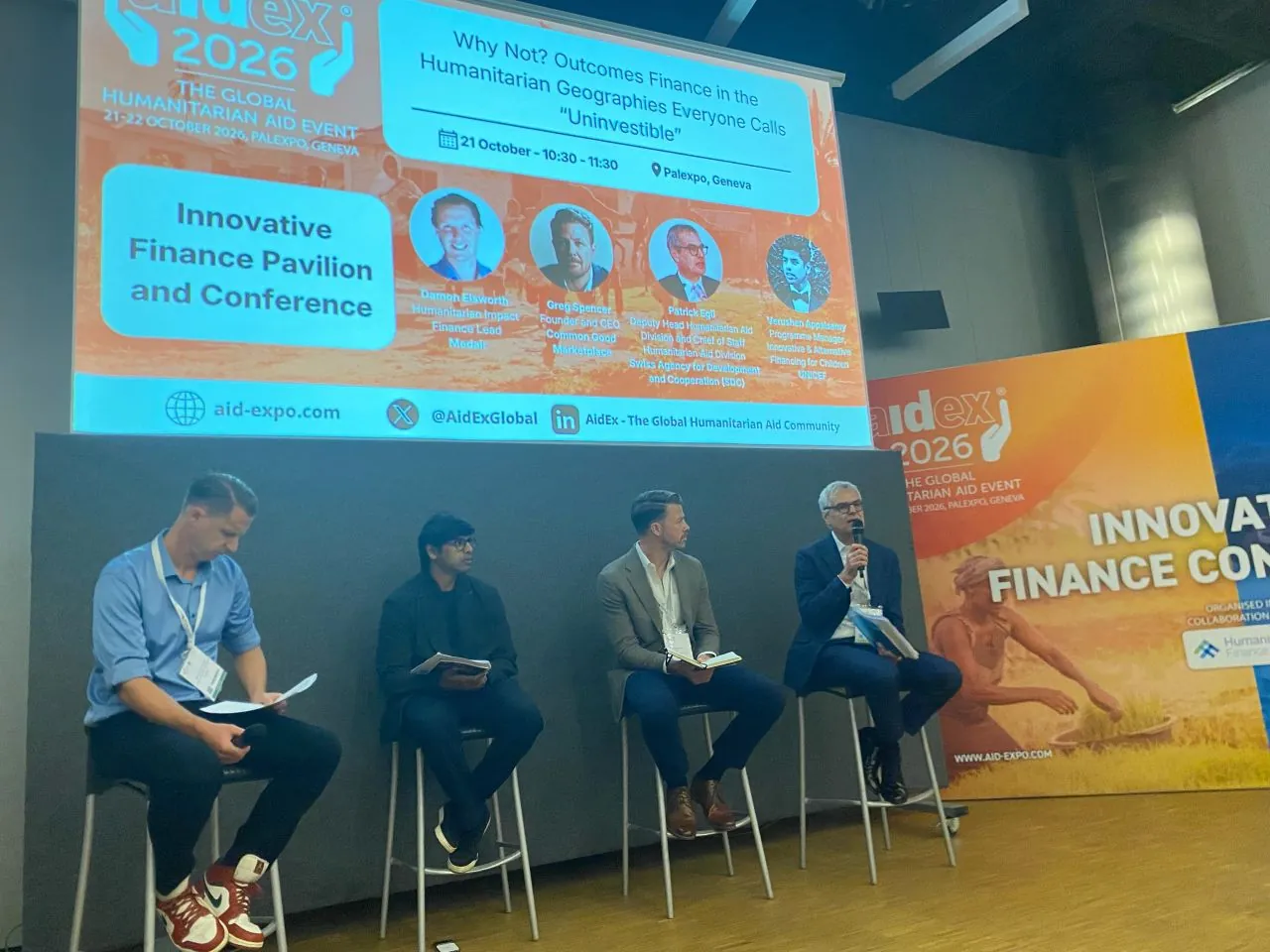
AidEx Geneva brings together more than 3,400 humanitarian professionals representing an estimated 1,500 organizations, including many of the world's largest humanitarian organizations and institutional donors. This year's Innovative Finance Conference, organized in collaboration with the Humanitarian Finance Forum, brought together practitioners and funders to examine how financing mechanisms can work in fragile and conflict-affected settings.
The backdrop was sobering. According to the OECD's 2026 projections, humanitarian assistance from major official donors fell by 35.8% in 2025. By May 2026, UN reporting indicated that more than 252 million people needed humanitarian assistance, while just 24.4% of the $33.7 billion required for humanitarian response plans had been received.
These aren't abstract budget reductions. Humanitarian organizations are increasingly making nearly impossible decisions about who among those starving, fleeing conflict, or without access to basic healthcare, education and shelter they won't serve.
Which brings us back to the question: can innovative finance help, or are we simply creating more complexity when resources are already stretched?
Can a marketplace actually improve humanitarian financing?
Our view is that an outcomes marketplace can deliver value in three ways: improving impact per dollar, mobilizing additional capital and reducing the cost and complexity of outcomes-based financing.
There's encouraging evidence for the underlying logic of outcomes-based financing. The Educate Girls Development Impact Bond in India, for example, achieved 160% of its learning target and 116% of its enrollment target, reaching 7,300 children across 166 schools. Tying financing to outcomes helped encourage adaptive program management and a greater focus on results, although exceeding targets doesn't necessarily prove that the financing instrument was more effective than conventional grant funding.
The challenge is that these instruments have historically been expensive, bespoke transactions that are difficult to replicate. A World Bank evidence review found that four development impact bonds studied under a UK government pilot incurred approximately $1.2 million in additional costs per project, or around 10% of their average budgets, compared with conventional fee-for-service contracting. Much of that expense came from legal arrangements, financial structuring and establishing customized systems for outcomes measurement and verification.
The logic of impact bonds is still compelling: provide upfront capital, link payments to independently verified outcomes and create incentives to improve results. But why should every organization have to negotiate an entirely new set of measurement standards, valuation methods, verification procedures and financial agreements to participate?
Our approach is to take the underlying logic of impact bonds and make it repeatable and scalable through shared marketplace infrastructure, rather than reinventing the mechanism with every transaction.
Interestingly, the Humanitarian Finance Forum reached a similar conclusion in its February 2026 paper, Scaling Humanitarian Impact Bonds: What Really Matters. Its assessment suggests that scaling depends less on sophisticated financial engineering and more on simpler interventions, institutional integration and supportive operating environments.
But standardizing the financing is only part of the equation. We also need a better way to understand and account for the outcomes being financed.

Standardization, accountability and impact per dollar
Humanitarian organizations have already demonstrated that standards can improve quality and consistency across an incredibly complex sector. The Sphere Handbook, for example, establishes internationally recognized minimum standards, technical indicators and accountability principles for humanitarian assistance.
But we haven't achieved the same degree of standardization for consistently measuring, valuing, verifying and financing improved outcomes across organizations and programs.
Why not?
Consider two organizations treating severe acute malnutrition in different countries. Both can report how many children were treated and what those treatments cost. But can funders consistently compare the additional lives saved or healthy life-years generated, taking into account different baselines, operating conditions and the strength of the evidence? Some organizations can, but the approaches aren't universally applied or readily comparable.
And this is certainly about more than making better capital allocation decisions.
It's as much about accountability for delivering verified outcomes as it is about deciding where capital should go.
We've become relatively good at reporting how many people we've reached, how many treatments we've delivered or how much funding has been deployed. But have we improved people's lives as intended, by how much, and how do we know?
Common outcome standards and independent verification can help answer those questions consistently, while giving institutional donors a stronger basis for demonstrating what their funding actually delivers.
There's already some excellent work happening to improve value for money in humanitarian action. CARE recently published findings from its analysis of more than 500 projects across 121 countries to better understand the economics of its programs. One example from Yemen found that shifting to a cash-for-work model for emergency latrine construction reduced unit costs by more than 20% while delivering latrines three times faster than traditional contracting.
Another important contribution comes from the CALP Network's May 2026 report, Show Me the Money: Efficiency and Effectiveness in Humanitarian Response. Drawing on data from 1,203 humanitarian programs representing $11.4 billion in resource transfers, the report found that value-for-money analysis is widely recognized but inconsistently applied, and is too often treated as a reporting requirement rather than a tool for improving programs.
There's also a difference between assessing delivery costs and measuring the additional outcomes and social value generated by that spending. Cost-benefit analysis, cost-effectiveness analysis and social return on investment (SROI) can all provide useful information, but they aren't interchangeable. Each answers a different question about costs, outcomes and value.
And the evidence base remains limited. A 2023 systematic review of humanitarian health research examined 269 published studies and found only 13, or 5%, were economic evaluations. That doesn't mean only 5% of humanitarian projects conduct economic analysis, but it illustrates the gaps in published evidence.
What we ultimately need is more consistent measurement of additional outcomes, their social value and how much funding was required to achieve them.
Importantly, this isn't an argument for funding only the people who are cheapest to serve. Humanitarian assistance is, and must remain, needs-based. Reaching people in remote, insecure and fragile contexts will often cost more, and those populations may be among the most vulnerable. The objective is to improve effectiveness within those realities, not create incentives to avoid difficult operating environments or exclude people with the greatest needs.
Greater impact per dollar should mean delivering better outcomes for the people who need humanitarian assistance most, not simply finding the cheapest people to reach.
Medair: From verified outcomes to financing humanitarian delivery at scale
One of the recurring challenges with innovative finance is how to achieve the level of measurement and assurance required by institutional funders without creating another expensive administrative burden for implementing organizations.
For organizations working in fragile contexts, building sophisticated monitoring, evaluation and financial reporting systems can be prohibitively expensive. Yet lowering the quality of evidence isn't a particularly good solution either.
Our partnership with Medair demonstrates how existing program data and established research can be used to measure, value, verify and finance humanitarian outcomes.
Medair's severe acute malnutrition program in South Sudan treats children facing life-threatening nutritional deficiencies, often in extremely difficult operating environments. Working together, we applied CGM's impact framework and verification process to existing treatment data, supported by peer-reviewed research linking successful treatment with improved survival.
The assessment covered 1,933 children's treatment records and estimated 369 additional lives saved. This translated into 5,718 Verified Impact Assets (VIAs), representing approximately $6.6 million in estimated social value. One VIA represents one additional year of improved well-being, valued using a human-capital approach that estimates the lifetime benefits of improvements in health, skills and knowledge.
Rather than requiring an entirely new evaluation from scratch, we worked from existing delivery records, established research and a structured verification process. The resulting outcomes were certified and made available for purchase through CGM's Marketplace.
To date, 521 VIAs have been purchased, generating more than $200,000 in funding for Medair.
This is an important proof point. It demonstrates not only that humanitarian outcomes can be measured, valued and verified, but that buyers are willing to purchase them, creating a new financing pathway for organizations delivering critical assistance.
We've demonstrated the full process, from program delivery and outcome verification to issuance and completed purchases. More importantly, we've demonstrated it in one of the world's most challenging humanitarian operating environments.
The next step is to take this proven transaction model and apply it at the scale of humanitarian delivery.
That's what we're now doing with Medair through the development of a “Humanitarian Outcomes Contract”.
Today, an organization can deliver a program, verify the outcomes and sell VIAs retrospectively and prospectively. This creates an opportunity to generate funding from results already achieved or projected in the future, but the organization still needs capital to deliver the intervention in the first place.
We need to bring that financing forward in a structured, repeatable, scalable way.
Through the proposed Humanitarian Outcomes Contract, upfront capital would finance Medair's health and nutrition programs, with outcome funders committing to purchase future verified results. Medair would deliver the interventions using existing operational and monitoring systems, while CGM's infrastructure would measure, value, verify and issue the outcomes as VIAs. Proceeds from outcome purchases could then repay upfront capital and potentially be recycled into further humanitarian delivery.
The underlying logic is similar to an impact bond, but with standardized outcomes and shared marketplace infrastructure that can support multiple programs and transactions.
Our successful experience with Medair provides the foundation to move forward with this structure at a much larger scale. Rather than developing another isolated pilot to test whether humanitarian outcomes can be verified and purchased, the focus is now on applying that demonstrated capability to a repeatable outcomes contract, with the financing, verification and transaction infrastructure designed for broader use.
Of course, scaling introduces important questions. What happens if an intervention underperforms? Who absorbs that risk? How can institutional donors make commitments to purchase future outcomes within their budget cycles and contracting requirements? And how do we ensure the financing mechanism delivers greater impact per dollar after accounting for all its costs?
These questions are central to the contract design and will continue to be evaluated as the model scales. They're not reasons to delay applying what we've already demonstrated, but considerations that need to be addressed in structuring and implementing the next generation of transactions.
The opportunity extends beyond Medair and beyond humanitarian health. The same infrastructure can support a wider range of verified outcomes across education, livelihoods, climate resilience and other areas where credible measurement can connect improved well-being with additional financing.
Additionality is the test of successful scale
Much of the conversation around innovative finance focuses on unlocking new pools of capital. That's important, but mobilizing capital alone isn't sufficient. We also need to demonstrate what additional value that capital generates.
We see three layers of additionality that matter.
First, additional impact. Are we delivering better outcomes than would otherwise have occurred? This requires understanding the baseline, counterfactual and evidence supporting the results. Paying for outcomes is not, by itself, proof that those outcomes wouldn't have happened anyway.
Second, additional capital. Are we mobilizing funding that wouldn't otherwise have been available, or bringing forward capital that allows humanitarian organizations to deliver assistance sooner or at a greater scale? The ability to turn future outcome purchases into financing for immediate delivery is particularly important in humanitarian contexts, where timing can make the difference between life and death.
And third, additional value. Are we generating greater impact per dollar after accounting for the costs of financing, measurement, verification and transactions?
This last point deserves particular scrutiny. Standardized marketplace infrastructure can reduce the need for bespoke transaction design, but we need to evaluate the full economics of outcomes financing against conventional funding, not simply compare one mechanism's transaction fee against another's total cost. And the comparison must account for the outcomes delivered, not just the expense of administering the financing.
If we're simply adding complexity and cost without creating additional value, we shouldn't do it.
Our experience with Medair has established the viability of measuring, verifying and transacting humanitarian outcomes. The outcomes contract is the next step in demonstrating how that approach can mobilize upfront financing, support larger-scale delivery and improve the economics of outcomes-based finance.
We'll continue to assess the impact, additionality and cost-effectiveness of this model as it scales, using that evidence to strengthen the structure and inform future transactions. The objective is not to assume that outcomes-based financing is always superior, but to deploy it where it can demonstrably add value and improve it through implementation.
This also doesn't mean outcomes-based financing should replace conventional grants. Unrestricted funding, emergency assistance and other established mechanisms will remain essential, particularly where outcomes cannot reasonably be measured or where performance risks cannot responsibly be transferred.
The opportunity is to complement those mechanisms, improve their effectiveness where appropriate and create additional financing pathways for organizations delivering meaningful, measurable outcomes.
From successful transactions to scalable impact infrastructure
What encourages us about the conversations at AidEx is the increasingly practical focus from institutional donors, humanitarian organizations and finance practitioners on how to finance verified outcomes, demonstrate greater impact per dollar and make these mechanisms work within existing humanitarian systems.
There's also growing recognition that infrastructure matters. Shared standards, credible valuation methods, independent verification and efficient transaction systems can make outcomes-based financing accessible to more organizations, rather than limiting participation to those with the resources and relationships to develop bespoke agreements.
This has the potential to change how organizations access capital. Instead of relying primarily on who you know, which RFP you can find or how persuasive your grant application is, organizations can increasingly demonstrate the outcomes they deliver and attract funding through a more transparent and accessible process.
Our experience with Medair has demonstrated that humanitarian outcomes can become verified, purchasable assets and generate meaningful funding for the organizations delivering them. That's a successful foundation on which to scale.
The Humanitarian Outcomes Contract is an opportunity to extend this approach from purchasing outcomes already delivered to financing future humanitarian delivery, building on a common framework that can be replicated across programs, geographies and sectors.
The work now is to put this infrastructure to use at a larger scale, bringing more buyers and delivery partners into the marketplace, structuring capital around verified results and continuing to measure the additional impact and value generated.
Given the extraordinary challenges facing the humanitarian sector, the answer can't simply be to do more with less.
We need to deliver greater impact with the resources available, mobilize additional capital and build greater accountability for the outcomes we fund.
Through our partnership with Medair, we've demonstrated how that can begin to work in practice. Now it's time to bring that model to scale across humanitarian delivery and beyond.
Explore Common Good Marketplace | Learn more about Medair's Verified Impact Assets